
Written for the person who has to make the case internally
-
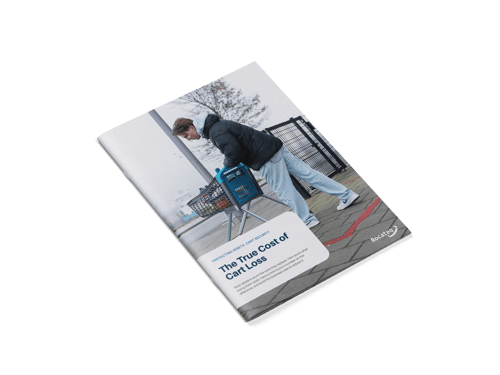
A method for building your own annual cost of cart loss, line by line — replacement, retrieval, labor and municipal compliance — from figures finance can check
-
The costs any containment system brings after installation, and what to ask about resets, batteries and boundary repairs before you sign
-
The questions asset protection and store operations teams ask before they buy, and the answers to demand from any vendor, including this one
Proof and limits
Rocateq's Cart Security uses a single antenna line that both locks and unlocks. The caster unlocks when the cart is rolled roughly three to five feet back in-bounds, so there is no remote controller required to unlock the caster. One electronic caster per cart, front right, with a 3V lithium battery rated four to five years and field-replaceable.
What this paper does not do
The most widely quoted figures for cart loss, from carts lost per store to industry-wide totals, trace back to trade estimates more than twenty years old, and we will not recycle them to make a page look authoritative. Where a current published figure exists, such as the retrieval fees California cities can now charge, it is cited with its source and year. Where it does not, the paper shows the method and labels every input illustrative, so you replace it with your own. We would rather hand you a number you can defend in front of finance than one that only impresses until it is checked.
A lost cart costs more than a cart.
Most of it is booked somewhere else.
A cart that leaves the property never shows up as a loss event. It shows up as a purchase order for replacement carts in one budget, an associate's afternoon spent rounding up carts from the lot next door in another, and a letter from the city in a third.
The replacement is the only part anyone adds up. That last line is new, and it is growing. California's SB 753, signed in October 2025, lets cities charge up to $100 for every cart they retrieve and raises the maximum penalty per occurrence from $50 to $100. Wildomar adopted its ordinance in August 2026, and other California cities have adopted similar rules. A cart that leaves the lot is no longer written off. It is invoiced.
So the argument you have to win internally is not about what a cart costs. It is about three costs that follow every cart off the property — costs no single report was ever built to add together.
Three costs your cart budget will never show you
01
02
03
Containment that needs an associate is labor you never approved.
A system that stops the cart at the boundary but needs someone with a remote control to reset it has moved the cost into payroll, not removed it.
There is a fourth cost, and it is the one you choose: what the system you buy to stop the other three will cost you to own, every year, after the installers drive away. The paper is about getting that number right.